
Post-quantum Cryptography: What’s Pqc And Why Does It Matter?

For numerous technical causes, present quantum computers aren’t highly effective sufficient to run Shor’s algorithm on the massive numbers wanted to interrupt the security systems getting used at present. Conventional public-key techniques rely on mathematical issues that quantum computers will eventually solve efficiently. Post-quantum algorithms rely on totally different mathematical foundations that presently haven’t any known environment friendly quantum attacks. The aim is resilience towards future quantum capabilities, whereas acknowledging that some confidentiality risks already exist at present as a result of harvested information. Public-key cryptography constitutes the biggest part of cryptographic deployments on the earth. Knowledge that’s presently not quantum-safe, whether or not it is saved or transmitted, and that should stay confidential for a long time, may be already at risk.
How Crucial Are Cryptosystems?
Ensuring trust, interoperability, and long-term security requires that quantum resistance is based on internationally recognized requirements. With Out these standards, organizations risk implementing options which could be incompatible, insecure, or short-lived. Post-quantum cryptography makes use of various mathematical buildings, similar to lattices, hash features or error-correcting codes. These issues don’t currently have recognized efficient solutions utilizing either classical or quantum computers.

To stay protected, we have to progress in the path of Post-Quantum Cryptography (PCQ), a new sort of public-key cryptography designed to withstand to each quantum and classical assaults. Many of the public key encryption algorithms in use at present rely on mathematical problems which would possibly be extremely difficult for classical computer systems to resolve. Quantum computers, nevertheless, could solve these issues much more efficiently after they attain adequate scale and stability. For a long time, organizations have relied on cryptographic algorithms which are thought of secure. As a end result, Post-Quantum Cryptography (PQC) is turning into a vital subject for security leaders answerable for protecting information – not just right now, however for years, or even decades to come back. At Present, many of the world’s knowledge is protected by encryption algorithms based mostly on complicated mathematical principles.
We mix our in depth cybersecurity experience with cutting-edge quantum experience to ship defensive solutions to help our shoppers keep ahead of emerging threats. NIST’s draft transition steerage deprecates quantum-vulnerable public-key algorithms (including RSA-2048) after 2030 and disallows them after 2035. That leaves six years to do work that has by no means been done in fewer than ten. Thales HSEs ship crypto-agile community encryption with a versatile FPGA-based architecture, enabling seamless migration to post-quantum security. Founded as a spin-out from the College of Oxford, PQShield brings together world-class cryptographers, engineers and security specialists.
Explore Safety Regulations, Business Requirements, And More
Red Hat’s objective is to assist prospects develop, take a look at, and put together for post-quantum cryptography turning into part of each step in product improvement. By this measure, an affordable recommendation could be to migrate to post-quantum crypto throughout the subsequent 10 years (i.e., to be fully migrated by 2035). Given the standardization and growth cycle for safety products, it means we need to be acting with urgency now. As A End Result Of if encryption can finally be broken, the architecture round it issues simply as a lot because the algorithm itself. It’s about constructing systems that are designed, from the beginning, to survive what comes subsequent. ZeroTier Quantum is designed to do exactly that — delivering high-performance, end-to-end quantum-secure connectivity without requiring organizations to rebuild what already works.
One can consider a quantum attacker who’s given a set of message-ciphertext pairs \((m, E_K(m))\). In reality, this latter mannequin seems unnecessarily robust and isn’t normally thought-about when evaluating the safety of current real-world systems. ZeroTier Quantum integrates it immediately into the inspiration, where identification, encryption, and connectivity are enforced collectively. Treating post-quantum cryptography as a transition rather than a change reduces risk and helps organizations keep away from disruptive, last-minute change. The federal authorities has mandated multiple businesses to help analysis and growth in quantum sciences and technology and to develop applications for growing the future quantum workforce.
Cryptographic Stock: Deriving Value Today, Getting Ready For Tomorrow
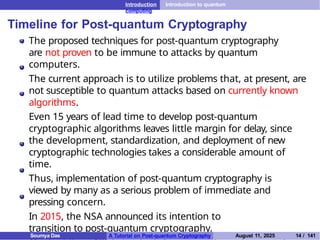
Data, gadgets and infrastructure typically outlive the algorithms designed to guard them. Making Ready for a post-quantum world is subsequently a matter of prudent cybersecurity planning, threat management and future-proofing. When will quantum computer systems be cryptographically related or capable of https://getbestdrone.com/tag/software/ fully break through our present cryptography? There’s no conclusive reply, but many estimates say it might happen within the subsequent 10–15 years. Some estimates suggest it might be sooner than that, even as early as 2029.
Correctly designed digital signature schemes used for authentication will remain secure until the day a suitable quantum computer truly comes online. Today’s quantum computer systems are restricted in measurement and, subsequently, pose no risk to present-day cryptography. And several vital engineering obstacles must be overcome before the menace becomes real. The embedded alternative cryptographic materials enable a public key infrastructure to make use of a number of cryptographic algorithms in a single object. Furthermore, it allows it to transition to the new cryptographic schemes whereas maintaining backward compatibility with methods using the present algorithms. Three X.509 extensions and three PKCS #10 attributes are defined, and the signing and verification procedures for the alternative cryptographic material contained within the extensions and attributes are detailed.
- Post-quantum cryptography, against this, is designed to run on present infrastructure, and integrates with current safety architectures.
- Cryptography is the cornerstone of cybersecurity, protecting our digital infrastructures and information.
- While classical signatures and encryption schemes based mostly on RSA, ECC, and so on, are all equally affected by Shor’s algorithm, the results that quantum attacks have of their usage is different.
- One can consider a quantum attacker who’s given a set of message-ciphertext pairs \((m, E_K(m))\).
- Many organisations operate complex environments with legacy techniques that can’t easily be up to date.
Bolting PQC algorithms onto legacy TLS isn’t sufficient; methods must be designed from the start to survive what comes next, which is the premise behind ZeroTier’s approach. Timing issues as a outcome of the migration window closes nicely before a cryptographically related quantum pc actually exists. There isn’t any precise or dependable timeline for when quantum computer systems will be capable of breaking today’s widely used public-key encryption.
Thales Quantum-ready Solutions
Once quantum computer systems turn out to be able to breaking current public-key cryptography, that information could be decrypted retroactively. Post-quantum cryptography (PQC) refers to cryptographic algorithms designed to be secure against attacks by quantum computer systems. Quantum computers, leveraging rules like superposition and entanglement, can solve sure mathematical issues exponentially faster than classical computers. This threatens the safety of classical cryptographic techniques like Rivest-Shamir-Adleman (RSA) and elliptic curve cryptography (ECC). Preparing for quantum computer systems and adopting PQC will be tough and time-consuming.